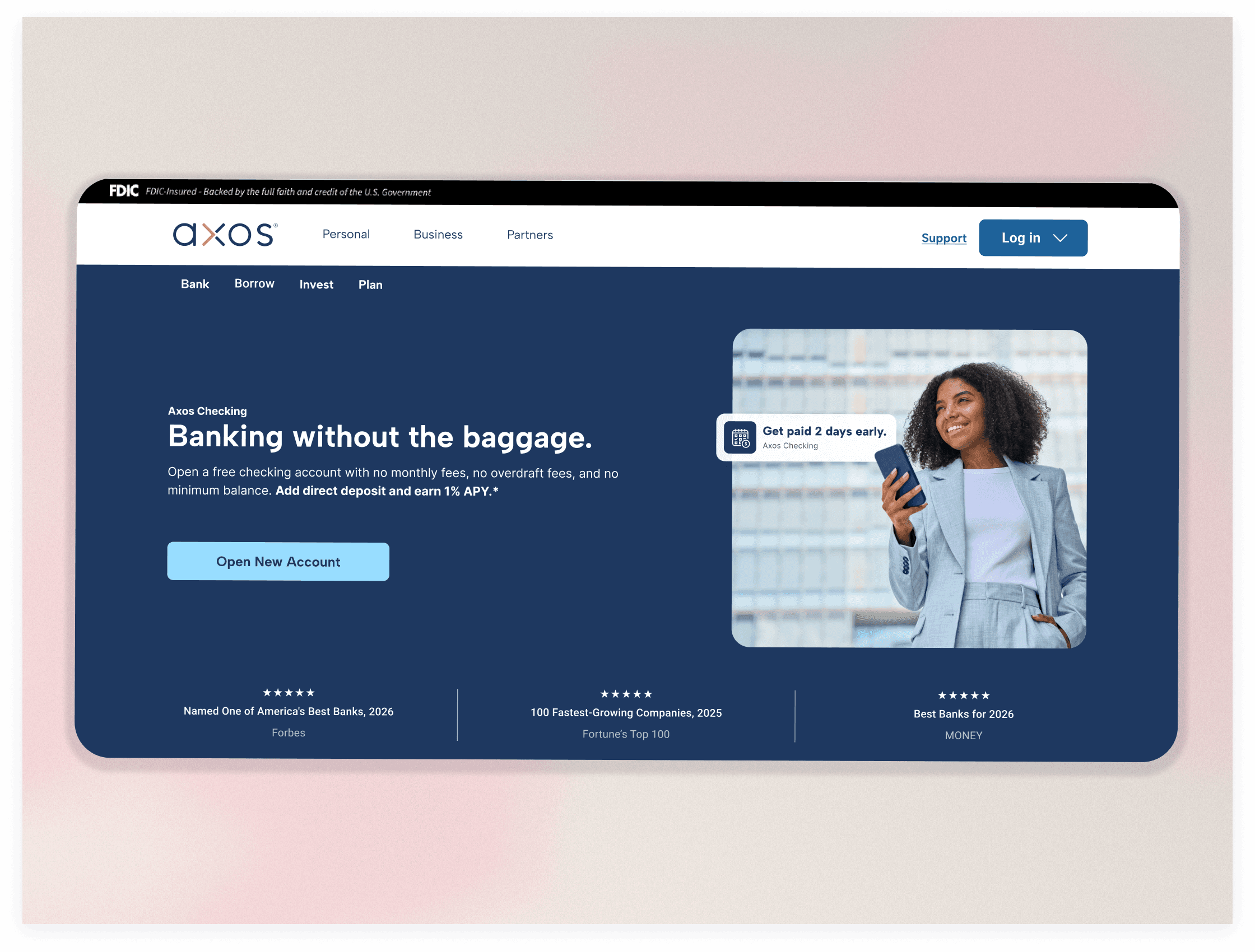
Axos ONE
2026
Building a lifecycle journey that closes the funding gap
Redesigning lifecycle messaging around where people actually drop off.

Overview
Getting people from signed up to actually funded.
Getting someone to sign up is a different problem from getting them to actually use the thing. In banking that gap is funding an account; in most products it’s the first real session, the first booking, the first completed action. This journey exists to close that gap: three tracks running on different audience conditions, built around what moves someone to fund rather than what performs well on open rate.
Problem
The journey was running. It wasn't converting.
By February, funding conversion had fallen to 12.2%, the lowest point recorded at the time. The sends were landing and the sequence was intact, but people were moving through the journey without funding at the end of it. The gap wasn't reaching customers themselves, it was that nothing of note in the sequence was doing the work of getting someone to actually move money.
Approach
Three paths, one customer.
I worked through a customer's ideal lifecycle before committing to writing emails, putting myself in their shoes while also walking the line of what goals we would want them to hit. I focused on where the branches go, what condition each track fires on, what happens when someone doesn't respond.
The journey isn't a single sequence. It's three tracks running on different audience conditions: a welcome track for anyone who opens an account, a feature utilization track that introduces the tools people don't discover on their own at days 15 through 37, and a funding recovery track that only fires for people who opened an account and never funded it. That last one is where the conversion work actually happens, and separating it out meant the recovery messaging could be direct about funding instead of buried inside general onboarding.
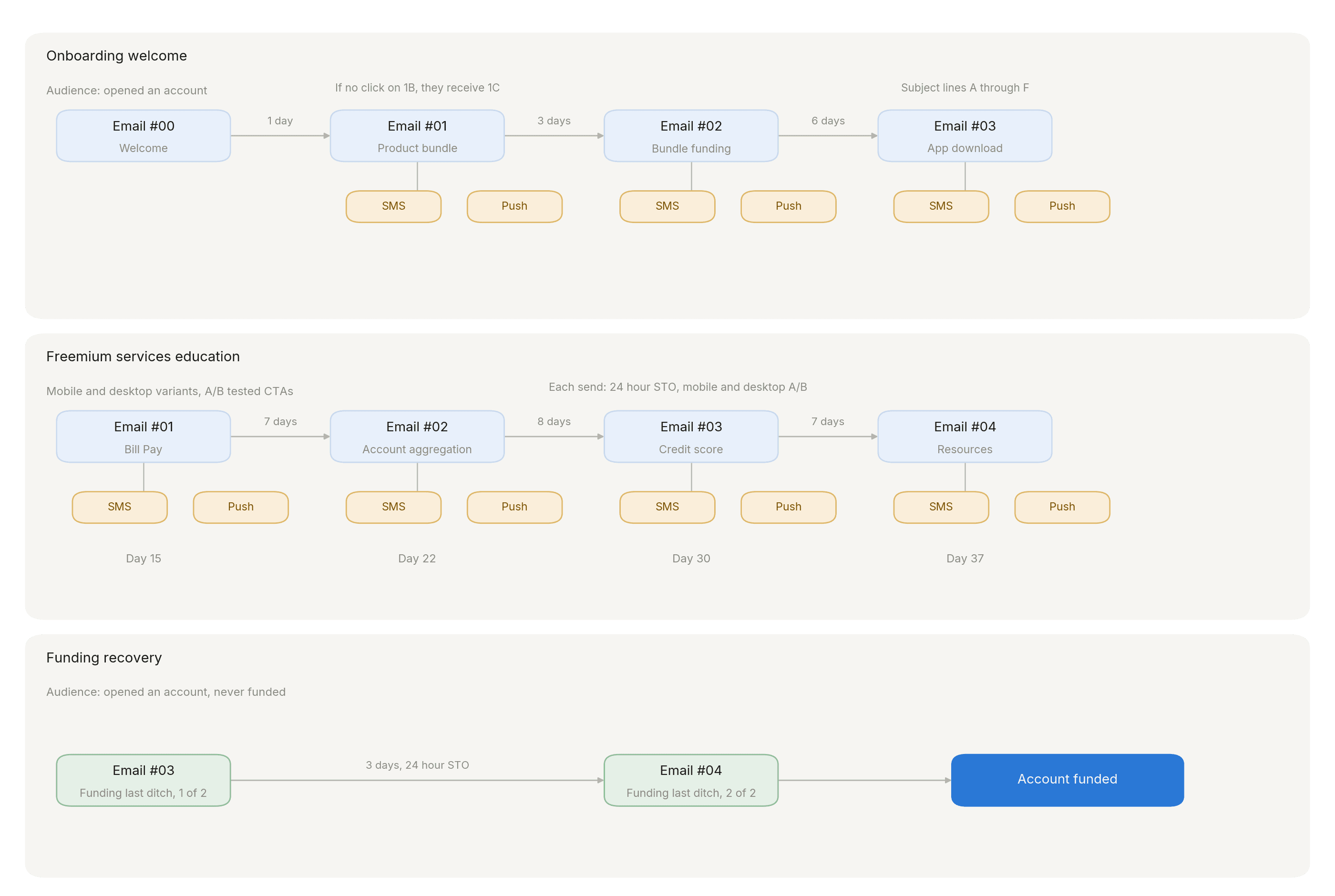
Every email ran subject line variants, up to six on the app adoption send, with mobile and desktop versions A/B tested against different CTAs. I narrowed nine subject lines down to the two that consistently performed. That elimination process is continuous rather than a one-time pass: the winners weren't the ones that read best on paper, and testing at volume is what surfaced the difference. The branching logic goes a level deeper than the send schedule, too. If someone doesn't click the first variant, they get the next one rather than dropping out of the sequence. While intricate, it ultimately helped me with boiling down to the best performers a few months after the journey had went live, and where it would have the most impact down the funnel.
Results
Conversion climbed 36% in four months.
Funding conversion moved from 12.2% in February to 16.7% in May, climbing every month across the window. Over that period the journey drove 3,270 funding conversions across 21,434 entries, $141.4M in total funded volume with $36.8M attributed directly to the journey. Open rate rose alongside it, 53.3% to 55.8%. Click rate ran between 3.2% and 4.2%. June was still in progress at the time and will take a few additional weeks to bake out.
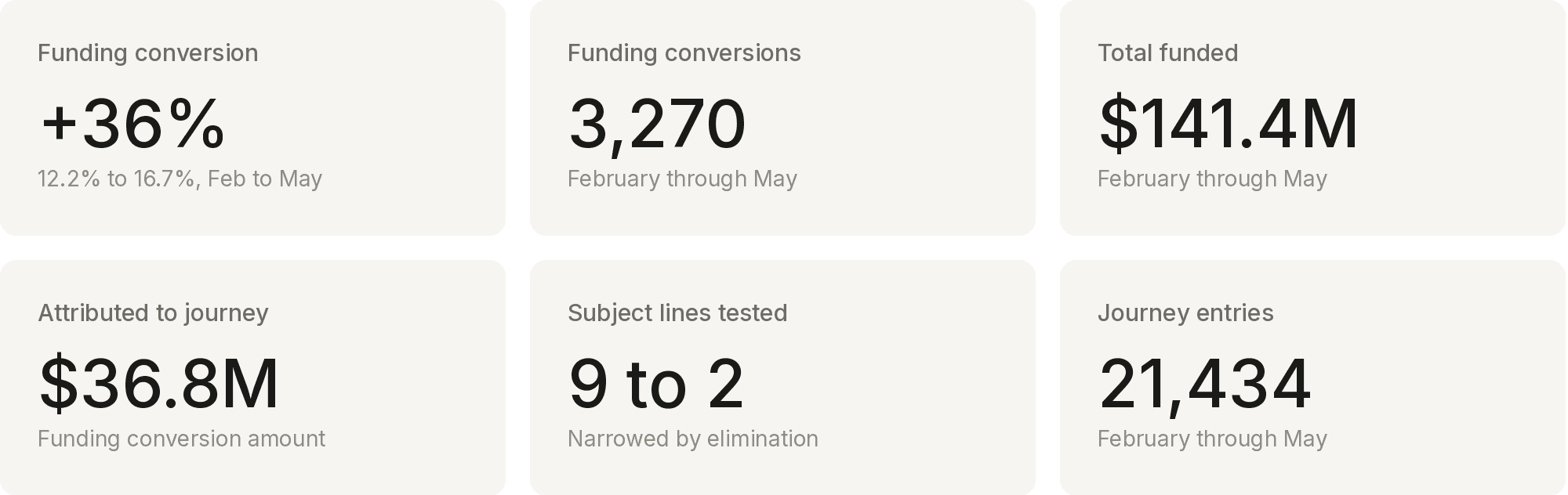
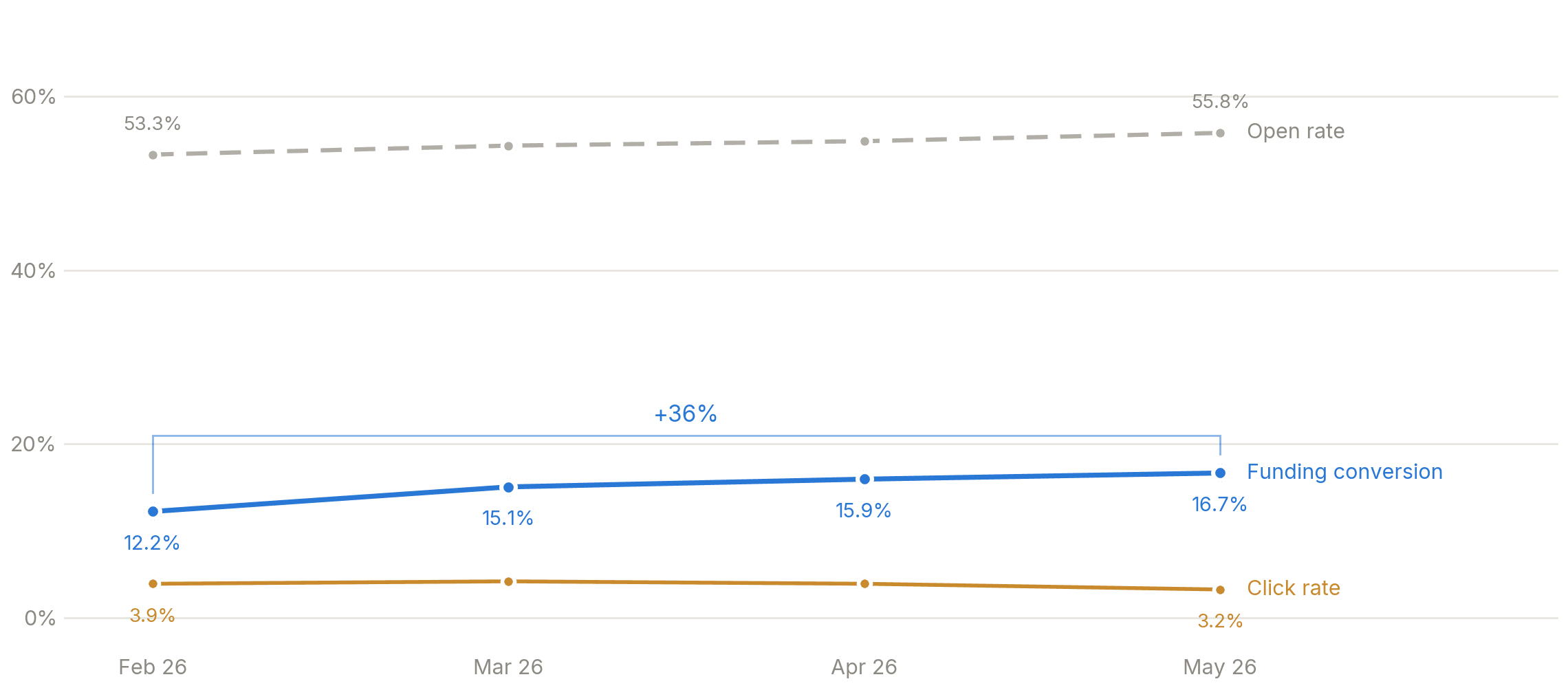
Conversions ultimately moved 36% over the course of four months, and while open rates and CTR only gradually increased, it shows how constant testing has downstream impact.